
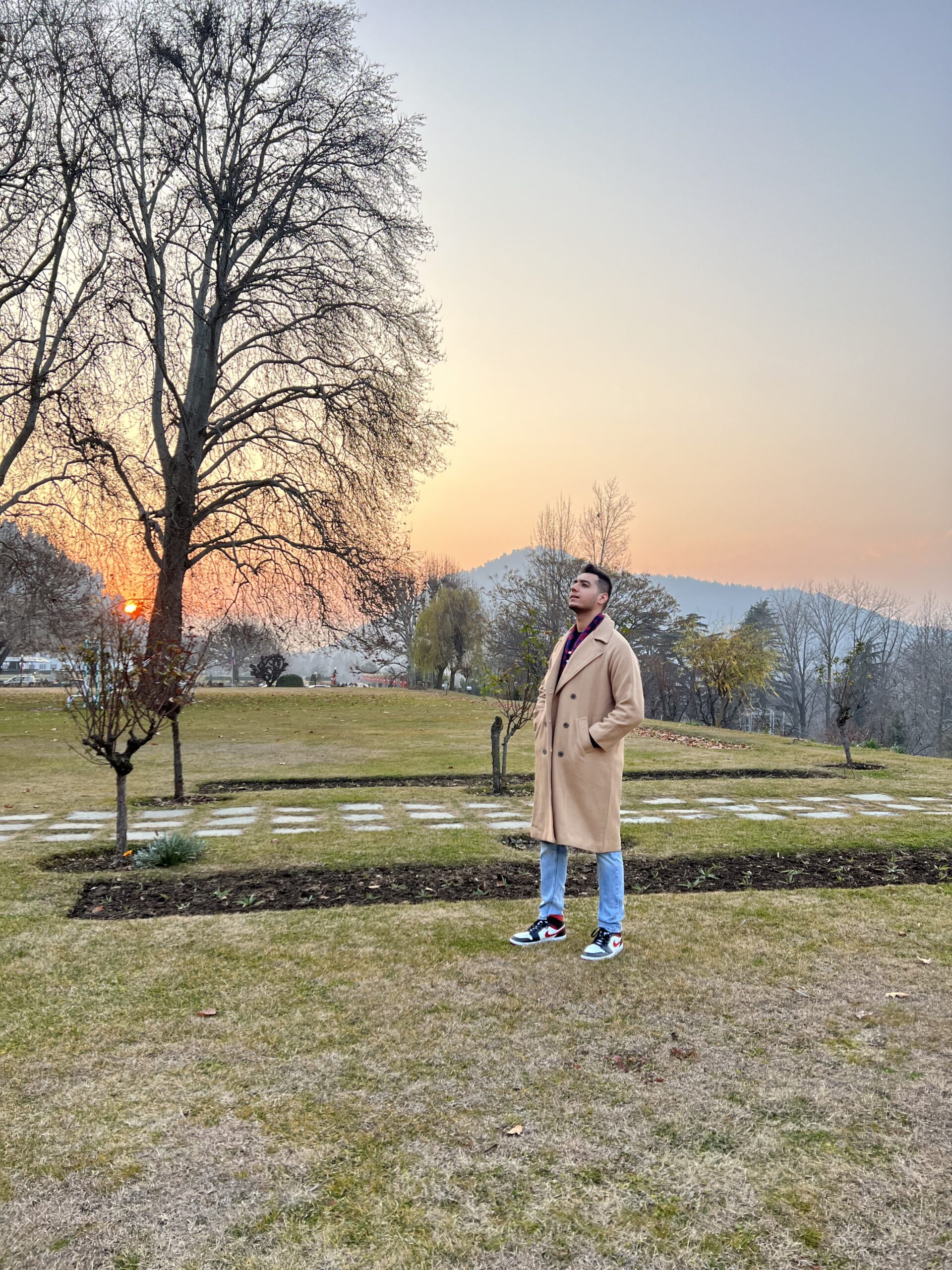
1. Sunset Story in Srinagar, Kashmir
There are sunsets that simply end the day—and then there are sunsets that pause time.
At The Lalit Grand Palace Srinagar, nestled on the banks of the iconic Dal Lake and framed by the majestic Zabarwan Range, every evening feels like a painting slowly unfolding in real time. But this evening was different. It wasn’t just beautiful. It was reverent.
I arrived earlier that day, weary from travel, seeking solace in a place that promised heritage and hush. As I stepped through the arched stone gateway of the former Maharaja’s residence, time seemed to bend slightly, like silk in the wind. The chinar trees, proud and rustling, welcomed me like old friends. History hung in the air—not dusty or distant, but alive, elegant, and waiting.
The Palace at Dusk
The concierge had recommended the west-facing garden for sunset. “You’ll see the palace blush as the sun leaves,” he said with a smile. Intrigued, I made my way there with a cup of steaming saffron kahwa in hand, the warmth comforting against the soft chill of a Kashmiri evening.
From the edge of the lawn, the scene stretched wide before me: Dal Lake shimmering like molten gold, shikaras gliding silently across its mirror-like surface, and above it all, the horizon slowly burning into a cascade of pinks, oranges, and deepening purples.
And behind me, the palace itself—its Victorian architecture glowing in soft amber hues. Once a royal residence, its sandstone walls seemed to soak in the light as if remembering every sunset that had ever passed through its windows.
Stories in the Silence
As I stood there, a strange stillness settled. Not silence exactly—there were whispers of breeze, a distant call to prayer, the rustle of leaves—but a kind of hush that asked for listening.
I imagined the Maharaja himself, perhaps pacing this very lawn, pondering state affairs or matters of the heart. I pictured poets under the arches, musicians tuning sitars in echoing halls, queens watching the same sunset through intricately carved jharokhas. This wasn’t nostalgia. It felt like presence. The palace didn’t remember the past—it held it.
“As the sun kissed the lake goodbye, the palace whispered stories only silence could tell.”
A Sunset That Stays With You
In a world of constant motion, what this moment offered was rare: stillness without stagnation. Beauty without performance. A sunset not for your camera, but your soul.
I sat there long after the light had faded. The lake turned slate blue, and the first stars began to shimmer above the ridgeline. Someone lit lanterns along the garden path. The sky and the palace had changed colors, but not mood. Everything remained quietly alive.
And I realized, this wasn’t just a luxury stay. It was something deeper—a soft homecoming to something old, sacred, and timeless.
Plan Your Sunset Sojourn
If you ever find yourself at The Lalit Grand Palace Srinagar, make time for the golden hour. Come with a warm drink, leave space in your mind, and let the palace do the rest.
You don’t need words.
Just watch.
And listen.
Kashmir the Heaven On Earth has one of the best sunset on the entire planet, this picture is of The Lalit Palace Hotel, Srinagar. The place is so calm and peaceful, a big ground with a lot of maple trees. There’s a quiet kind of magic in chasing sunsets—those fleeting moments when the sky becomes a canvas of fire, gold, and rose. Whether you’re sitting on a quiet beach, standing on a mountain ridge, or watching city rooftops glow, sunsets remind us to slow down and savor the present.
2. Sunset story in Jaisalmer, Rajasthan
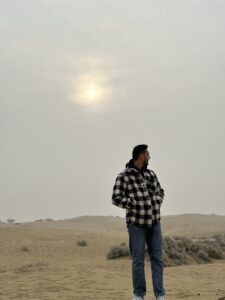
There’s something quietly monumental about a desert sunset. No fanfare, no noise—just golden light spilling over endless dunes, and a kind of stillness that settles deep into your bones. In Jaisalmer, Rajasthan, the Thar Desert becomes a canvas every evening. And watching the sun set here is not just a visual experience—it’s an emotional one.
Into the Dunes
It began in the late afternoon, when the city’s golden walls still shimmered under the high sun. A jeep picked me up from my haveli in the old city, winding through narrow streets before bursting into the open land. After an hour’s drive past scrub brush and scattered camels, we arrived at a quiet section of the dunes—not Sam, where the crowds gather, but a lesser-known spot near Khuri, where the sand is soft and undisturbed.
A camel named Raju waited, adorned with bright Rajasthani embroidery. I climbed aboard and we moved slowly into the deeper dunes. The city felt far away now. The only sound was the soft crunch of hooves in sand and the occasional rustle of wind over the cresting dunes.
The Gold Hour Begins
As the sun began its descent, the transformation was immediate and magical.
Shadows stretched long and languid. The sand turned from yellow to amber, then a warm rose-gold. Each ripple in the dunes caught the light differently—some sharp, others soft like velvet. The sky, once blue, melted into a gradient of peach, lavender, and finally, a deepening orange that felt like fire without heat.
I sat down on the highest dune, legs folded, eyes wide. Around me, silhouettes of other travelers—just dots in the distance—stood in reverent quiet. Even the camels seemed to pause.
The Desert’s Silence
There was no rush. No clicking of phones. No pressure to speak.
The desert didn’t need words.
It spoke in colors, shadows, and stillness.
A local folk musician began to play a rawanhatta nearby. Its haunting tones floated across the sand, blending perfectly with the hush. Someone passed around a brass kettle of sweet chai. We sipped, and watched.
At that moment, I understood why people say the desert reveals things to you—not with answers, but with space.
After the Light Fades
As the sun finally sank below the horizon, the sand cooled instantly. The sky went from fire to ash, stars slowly appearing one by one. We rode back by firelight, the quiet somehow louder in the dark.
That night, back at the camp under a canopy of stars, I journaled this:
“In the city, the sunset ends your day.
In the desert, it begins something else entirely.”
Planning Your Own Desert Sunset
If you’re heading to Jaisalmer, don’t miss a sunset in the Thar. Skip the crowded areas and ask your host for a more secluded experience near Khuri or Khaban. Opt for a camel ride, carry something warm, and bring no expectations. The desert will do the rest.
Just remember:
You’re not just watching the sun go down.
You’re watching the earth exhale.
3. Sunset story in Landour, Uttrakhand
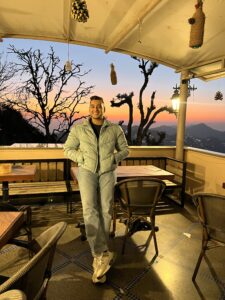
There are places where time lingers a little longer. Landour is one of them.
Perched quietly above Mussoorie, this old British cantonment isn’t just a hill station—it’s a mood. A memory. A corner of the world where cobbled roads, whispering pines, and rusting rooftops haven’t changed much in decades. And as I stood near the old clock tower, watching the sun dip behind the rolling hills, I realized—this was the kind of sunset that could have walked straight out of a Ruskin Bond story.
The Walk to Sisters Bazaar
I had arrived earlier that afternoon, escaping the bustle of Mussoorie’s Mall Road. Landour felt immediately different. The air was quieter, the trees taller, and the people fewer. I wandered slowly, past ivy-covered cottages and cinnamon-scented bakeries, toward Sisters Bazaar.
A light breeze carried with it the scent of pine and old woodsmoke. Somewhere, a dog barked. A bell rang faintly from a chapel. It all felt like the prelude to something quietly beautiful.
I found a small bench just outside the Prakash store, with a perfect view of the western ridge. The sun had begun its slow descent, casting long golden shafts through the forested slopes.
A Ruskin Bond Sunset
I pulled out a dog-eared copy of Ruskin Bond’s Rain in the Mountains, the one I always carry to the hills. “Mountains are not only about height,” he once wrote, “they are also about depth.” As the valley filled with misty shadows, I understood exactly what he meant.
The rooftops turned molten under the fading light. Birds flew home in gentle arcs. The distant city of Dehradun began to flicker to life far below. And above it all, the sky glowed in soft tones of amber, lilac, and the faintest blush of rose.
It was the kind of sunset that didn’t shout—it whispered. Not dramatic, but deliberate. Not a spectacle, but a slow unfolding. The kind of beauty Ruskin Bond wrote about so often: subtle, everyday, and deeply felt.
“As the sun faded, so did time—and all that remained was story.”
The Magic of Landour Evenings
In Landour, you don’t chase the sunset.
You let it come to you.
It arrives gently—through the trees, across the ridgelines, along the curved roads where the past hasn’t quite let go. It’s a moment that makes you look up, then inward.
And when the light finally disappears, it leaves something behind: a quietness, a stillness, and a strange sense that maybe you’re not in a hurry after all.
Planning Your Own Landour Twilight
If you find yourself in Mussoorie, take the extra turn to Landour. Go in the late afternoon. Stop for fresh cinnamon rolls at Landour Bakehouse or a hot chocolate at Emily’s. Walk the loop. Find a bench. Bring a book—or better yet, just your senses.
The hills will do the rest.
And who knows?
You might just find yourself living a page out of Ruskin Bond’s next story.
4. Sunset Story at Lake Pichola, Udaipur, Rajasthan
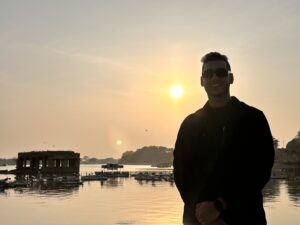
Some cities are known for their noise. Udaipur is known for its quiet.
Even in its most photographed moments—its marble palaces, mirrored lakes, winding streets—Udaipur feels like it’s been dipped in stillness. Nowhere is this more true than at Ambrai Ghat, just before sunset, when the day begins to let go and the city begins to glow.
That’s where I found myself one golden evening, camera in hand but heart wide open, watching the light disappear behind the City Palace, and realizing I didn’t need to capture the view. I just needed to witness it.
The Approach
Ambrai Ghat sits at the edge of Hanuman Ghat, across from the sprawling silhouette of Udaipur’s most iconic structures: the City Palace, Lake Palace, Jag Mandir, and the gentle arc of the Aravalli Hills. It’s not far from the luxury hotels and busy restaurants, yet it feels like a sacred pause—a place designed for sitting, watching, and letting the world slow down.
I arrived just before 6 PM. Locals were feeding the lake’s fish near the stone steps. A priest quietly lit incense near the small Hanuman temple. Travelers, like myself, sat in gentle rows on the wide ghat, cameras forgotten on laps, eyes fixed on the water.
The sun, still high but dipping quickly, was starting to turn orange—casting long shadows over the white façades of the palaces across the lake.
The Moment the Light Changes
There’s a moment—just a few minutes long—when Udaipur turns from beautiful to surreal.
The City Palace, with its honey-colored sandstone, begins to glow from within as if lit by memory itself. The Lake Palace, resting like a mirage in the middle of Lake Pichola, catches every ray and throws it back across the water. The surface of the lake transforms into fire—fluid, flickering, and impossible to hold.
Around me, no one spoke. Even the children who had been skipping stones earlier had gone quiet, mesmerized.
Then came the breeze—soft and scented with temple incense. Somewhere across the water, the sound of a conch echoed faintly, followed by the slow rhythm of the evening aarti.
“It wasn’t just a sunset—it was the city exhaling light.”
Connection in Stillness
What struck me most was not the view, though it was magnificent. It was the collective silence. Strangers—couples, solo travelers, old men with prayer beads—shared something without speaking. We were all watching not just a sunset, but a city remembering itself.
Here, at Ambrai Ghat, you don’t just see Udaipur.
You feel it.
You feel the centuries of kings and queens who stood on balconies across the lake, watching this same light. You feel the poetry that has drifted across its waters. And in some strange way, you feel yourself—stripped of noise, softened by gold.
After the Light Fades
As the last streaks of orange bled into purple, lights flickered on along the ghats and palaces. The magic didn’t end. It simply changed form—from sunlight to lantern glow, from vision to memory.
I walked back slowly toward my hotel, my feet light, my thoughts quieter. I didn’t check my photos that night. I didn’t need to.
I had seen something too sacred for screens.
Tips for Visiting Ambrai Ghat at Sunset
Best Time: Arrive around 5:30 PM for a winter sunset, or 6:30 PM in summer.
What to Bring: A shawl, a notebook, and no rush.
Where to Sit: Find a place near the lower steps for uninterrupted views.
Pro Tip: After sunset, have dinner at Ambrai Restaurant nearby—one of the finest lakeside dining spots in Udaipur.
Whether you’re a photographer, a poet, or a traveler simply passing through, a sunset at Ambrai Ghat offers something rare:
A moment of presence.
A city in prayer.
A palace on fire—with light, not flame.
5. Sunset story in Bikaner, Rajasthan
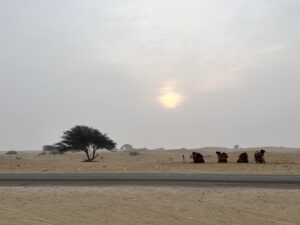
The desert doesn’t speak loudly.
It waits. And then, at sunset, it whispers everything you need to hear.
Just outside Bikaner—beyond the tangled lanes of the old city and the regal outline of Junagarh Fort—the Thar stretches wide and empty. But unlike the postcard-famous dunes of Jaisalmer, Bikaner’s desert is quieter, less visited, more intimate. It’s not showy—it’s soulful.
That’s where I went, one late afternoon, chasing not just a sunset, but a story written in sand and silence.
The Journey Begins
We drove toward Raisar, a small desert hamlet about 20 kilometers from Bikaner, where the dunes begin to roll gently like sleeping waves. Waiting for us were two camels—tall, serene, dressed in bright Rajasthani tassels—led by Lakhan, a local herder whose family has raised camels for generations.
As we mounted and began our slow sway into the desert, the town fell away. The only sounds were the creak of saddle leather, the crunch of camel feet on sand, and the occasional call of a desert bird. The wind carried nothing but quiet.
As the Sky Begins to Change
After an hour, we reached a high dune with a full view of the open horizon. Lakhan motioned for us to dismount. He pulled a brass kettle from his saddlebag and began to prepare tea over a small fire—just twigs and dry roots, the way his ancestors had done for centuries.
And that’s when the desert began to change.
The sun, once harsh and white, started melting into amber. The sky turned saffron and blush. The camels—majestic in profile—stood against the horizon like shadows from a half-remembered dream. The dunes glowed gold at the ridges, deepening into violet in the troughs.
Dust rose in soft spirals from distant caravans making their way home. It wasn’t dramatic like a city skyline. It was deeper than that. Quieter. Real.
“The desert didn’t say much. But the sky spoke loud and clear.”
Stories Around the Fire
As we sipped hot chai in tiny clay cups, Lakhan told us stories of his father’s days as a camel trader. Of walking to Pushkar for the annual fair. Of camels who remembered faces. Of dunes that changed shape overnight.
There were no tour groups. No clicking cameras. Just stories and stars.
Soon, the fire was the only light left. The sunset had finished its show, but it left behind a stage lit with constellations. Even the wind seemed to hush out of respect.
The Ride Back
We rode back in near-darkness, the camels confidently navigating the dunes. In the distance, the faint orange lights of Bikaner began to flicker like tiny fires, while behind us the stars multiplied with every step.
No music. No Wi-Fi. Just this immense, impossible silence that felt sacred.
Planning Your Desert Sunset near Bikaner
Best Spot: Ask your guide for dunes near Raisar or Khichan—quieter than tourist-heavy zones.
Best Time: October to February, arrive around 4 PM to settle in before sunset.
What to Bring: A scarf, water, and openness. The desert rewards stillness.
Pro Tip: Book with a local camel herder or eco-camp like The Camelman, Raisar Camps, or Narendra Bhawan’s desert experiences for authenticity.
In the desert near Bikaner, the sunset isn’t just something you see.
It’s something you feel.
In your chest.
In your breath.
And sometimes, if you’re lucky, in the stories the wind carries long after the light fades.