
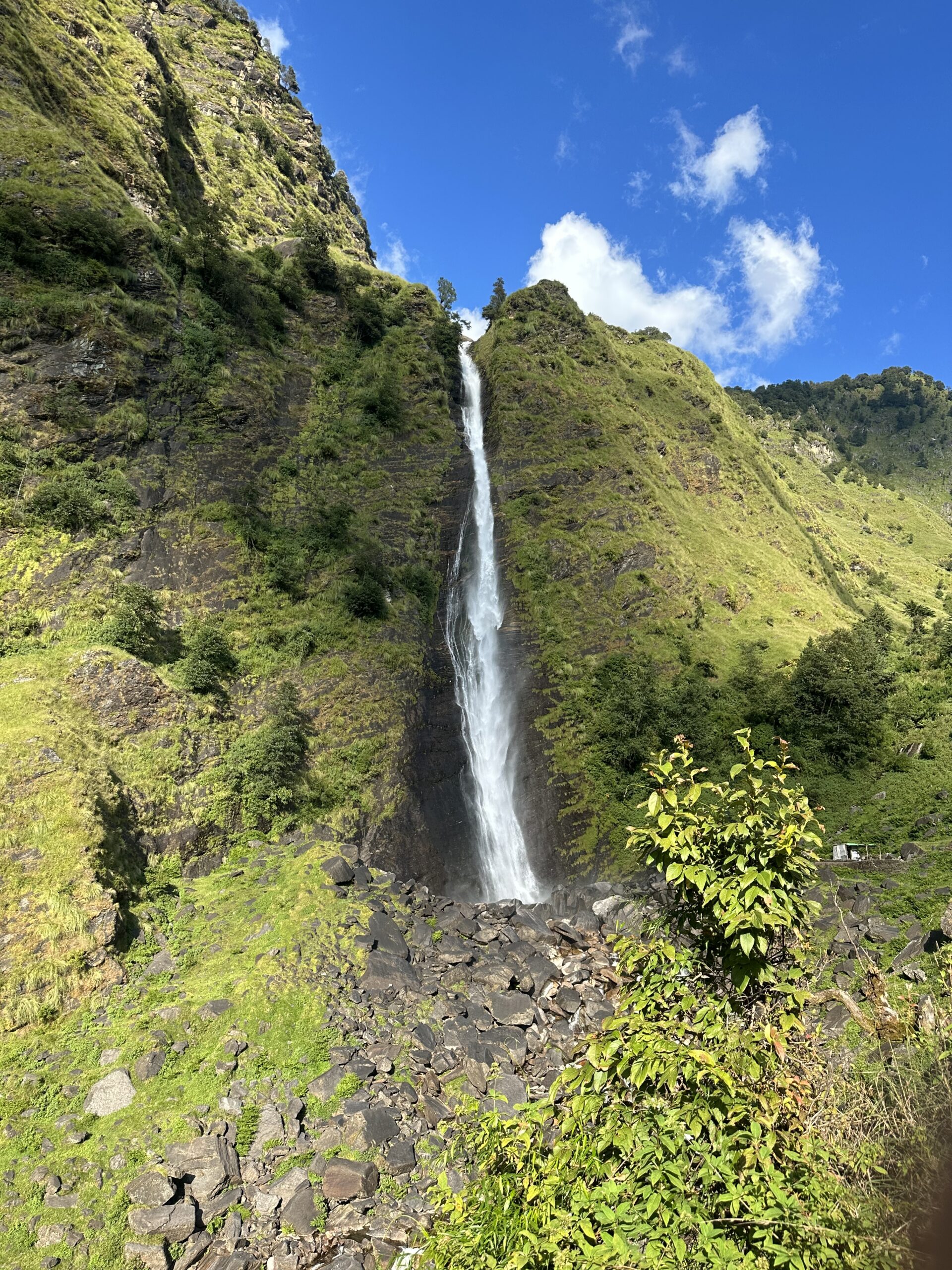
1. Birthi Falls, Munsiyari, Uttrakhand
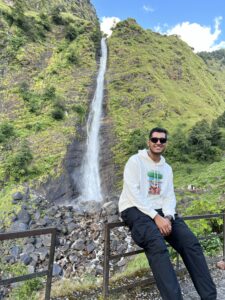
There’s a special kind of magic in discovering a hidden waterfall for the first time. The way the sound calls you—distant, teasing, almost like a secret waiting to be unveiled. My journey to Birthi Falls in Munsiyari began with that very call.
The Trek Begins
Early morning, the air crisp and fragrant with pine, I set out from the quiet village of Birthi. The trail wound gently uphill through dense deodar forests, where shafts of sunlight filtered through the thick canopy, casting mottled patterns on the forest floor. The only sounds were the soft crunch of my boots on the earth, the occasional chirp of a bird, and that distant roar—growing louder with every step.
With every turn, the forest seemed to hold its breath. Moss-clad rocks glistened under dew, and wildflowers peeked shyly from between tree roots. The fresh mountain air was sweet and sharp, filling my lungs and clearing my mind.
The Waterfall Revealed
Then, suddenly, the path opened to a clearing. And there it was.
Birthi Falls appeared like a shimmering veil, tumbling gracefully over rugged rocks and mossy ledges. The cascade wasn’t the tallest or the loudest I’ve ever seen—but it was perfect. A curtain of water whispering secrets in every splash.
The spray formed a fine mist that kissed my face, cool and alive. Sunlight caught the droplets, scattering tiny rainbows that danced with the breeze. I found a smooth boulder nearby and sat down, letting the sound of falling water fill the silence.
Nature’s Quiet Power
What struck me most wasn’t the waterfall’s roar—it was the calm beneath it. The way the forest seemed to cradle the falls, absorbing the sound and turning it into something gentle, almost sacred. The birds resumed their songs, and a soft wind stirred the pines, as if the whole world was breathing in sync with the water’s rhythm.
In that moment, the waterfall felt less like a force of nature and more like a living, breathing being—whispering stories of the mountains, the rains, and the forests. I closed my eyes and let myself be carried by its song.
“The falls didn’t just fall—they whispered secrets in every splash.”
Visiting Birthi Falls
Getting There: Birthi Falls is a moderate trek from Munsiyari town, about 5 km along well-marked trails through forests and small streams.
Best Time: March to June and September to November offer the clearest skies and the most comfortable hiking weather.
What to Bring: Good trekking shoes, water, a light jacket, and your curiosity.
Tips: Start early to enjoy the solitude and watch the morning light filter through the trees.
Why Birthi Falls?
For those seeking more than just a photo opportunity—more than the usual tourist trail—Birthi Falls offers a rare gift: a chance to slow down, listen, and feel the heartbeat of the Himalayas.
The falls don’t shout for attention. They invite you to come closer, to discover their quiet stories, and to be part of something timeless.
2. Jharipani Waterfall, Mussoorie, Uttrakhand
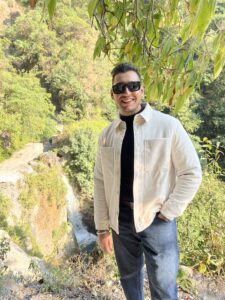
Most travelers arrive in Mussoorie for the bustle of the Mall Road, the echoes of colonial charm, and the sweeping views from high terraces. But just beyond the noise—tucked away on a quiet trail below the town—waits something softer, older, and more quietly profound.
That’s how I found Jharipani Waterfall. Not on a guided tour or by following a crowd. But by walking slowly, early in the morning, toward the sound of falling water I could not yet see.
The Forest in First Light
I set out just past 6 a.m., when the mist still clung to the pines and the air was laced with dew. The road to Jharipani village was hushed, save for the gentle waking call of hill birds. With each step down the path, the town faded behind me, replaced by the comforting hush of forest and footfall.
There was no drama—no signboard, no souvenir stand. Just a winding, earthy trail where light filtered through tree branches in soft columns. For a while, I wasn’t sure if I was walking toward anything at all. But then, I heard it.
A low, steady sound. Not loud. Not sharp. But rhythmic. Familiar, like a hum. The sound of water falling.
“The waterfall didn’t arrive all at once—it appeared like a song building slowly from silence.”
The First Glimpse
I rounded a bend, and there it was.
Jharipani Waterfall, cascading gracefully over rocks worn smooth by decades of monsoon. The water didn’t roar—it slipped and shimmered, gliding over mossy ledges into a shallow pool below. Sunlight had just begun to touch the top of the falls, turning the mist into a soft gold haze. Wild ferns framed the scene like green lace.
I sat on a flat stone nearby, shoes damp with morning grass, breath held without meaning to. There was no one else around. Just the water, the forest, and me.
The Moment Beneath the Mist
I stepped closer, letting the fine spray touch my face. It smelled like pine, cold stone, and wet earth. I dipped my fingers into the stream and let the current tug gently—an ancient greeting.
Here, in the quiet of the morning, I didn’t feel like a visitor. I felt like a listener. As if the waterfall had waited through the night just to sing this first song of the day.
It wasn’t dramatic like some Himalayan giants. But that’s what made it so special. Jharipani Waterfall doesn’t try to impress. It simply exists. Patient. Present. Flowing with purpose.
Tips for Visiting Jharipani Waterfall
Start Early: Arrive before 8 a.m. to enjoy the trail and falls in peaceful solitude.
How to Reach: From Mussoorie, take a short drive to Jharipani village, then hike down a 1.5 km trail.
What to Bring: A water bottle, light jacket, sturdy shoes, and something to sit on.
Best Season: March to June or post-monsoon (Sept–Nov) when the falls are flowing but the trail is clear.
Final Thoughts
In the end, I didn’t just discover a waterfall. I found a moment—a pause in time where the only thing that mattered was light, water, and breath.
So if you’re in Mussoorie, wake up early. Walk slowly. Listen. And let Jharipani Waterfall sing you its quiet, beautiful song.
3. Bhalugaad Waterfall, Mukteshwar, Uttrakhand
Sometimes, the most unforgettable places are the ones you don’t plan for—the ones whispered to you by locals over chai or mentioned casually in a corner of a travel blog. Bhalugaad Waterfall, tucked deep into the woods near Mukteshwar, was one such discovery for me.
I didn’t know what to expect when I set off that morning. I only knew I needed to hear the sound of falling water, and let the forest do what forests do best—quiet the mind.
A Forest Path and the Sound of Water
From my homestay in Mukteshwar, it was a short drive to the trailhead. A local guide pointed out the way, smiling: “No noise there, only water and birds.”
The trail wasn’t long—about 1.2 kilometers—but it was shaded, quiet, and lush. Oak and rhododendron trees flanked the path, and the sun blinked in and out through leaves. I walked alone, save for the occasional flutter of wings and the unmistakable gurgle of something ahead.
There’s something sacred about walking toward a waterfall. You don’t see it at first—you hear it. Distant. Teasing. Like a promise.
The Reveal: Water Meets Stone
And then, there it was.
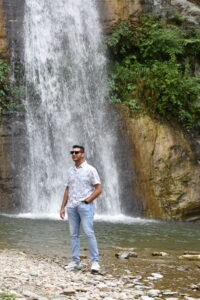
Bhalugaad Waterfall—clear, clean, cascading from a rocky ledge into a cool, shallow pool. It wasn’t roaring or massive, but it didn’t need to be. It was gentle, pure, and framed by wild greenery like something out of a forest fable.
The rocks were smooth and damp underfoot. I kicked off my shoes, dipped my feet in the cold water, and leaned back on a mossy stone. Time, for a moment, forgot to move.
“In the hush between water and rock, I heard everything I’d forgotten to listen to.”
A Place for Stillness
There were no crowds. No signs. Just a natural amphitheater of stone and silence. A few butterflies floated through the mist, and birds called to each other in the canopy. I saw a young couple arrive with a thermos of chai and sit quietly beside the pool. They didn’t speak. They didn’t need to.
That’s the kind of place Bhalugaad is. Not for thrills. For pauses.
For taking off your watch and your worries.
How to Visit Bhalugaad Waterfall
📍 Location: About 3–4 km from Mukteshwar town, near Dhari village.
🥾 Trek Length: ~1.2 km one-way through forest (easy to moderate).
🌿 Best Season: March–June and September–November. Avoid during heavy monsoons due to slippery trails.
📸 Tip: Visit early morning to enjoy solitude and great natural light for photography.
Final Thoughts
Bhalugaad Waterfall isn’t the kind of place you cross off a list. It’s the kind of place you carry home in your breath. In your photos. In that slight dampness on your shoes from a mountain stream.
So if you’re in Mukteshwar, ask the trees where to go.
They’ll send you to the sound of water falling—softly, surely, steadily—just waiting to be found.
4. Jogini Waterfall, Manali, Himachal Pradesh
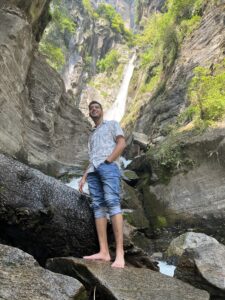
They say every waterfall is a story waiting to be told. In Manali, that story unfolds slowly—through apple orchards, pine-lined paths, and the rising hum of falling water echoing through the hills. At the end of it all, where forest and sky meet, you’ll find Jogini Waterfall, not just a destination, but a gentle revelation.
The Journey Begins in Vashisht
My day began in Vashisht, a village just a few kilometers from Manali, known for its hot springs and ancient temples. But this morning, I wasn’t here for temples—I was here for the trail behind them, the one that winds upward toward one of the region’s most serene natural wonders.
With a bottle of water and nothing but time, I began the gentle hike. The air was cool and carried the scent of pine and damp earth. Villagers passed by with bundles of kindling, smiling in greeting. Prayer flags fluttered on the path, reminders of the sacredness of these hills.
The higher I climbed, the more the sounds of the village faded—replaced by birdsong, the rustle of trees, and the distant, rising murmur of the waterfall.
The Waterfall Appears
After about 45 minutes of walking, the trees parted—and there it was.
Jogini Waterfall, pouring down a high cliff face in a white ribbon, crashing onto the rocks below before disappearing into a stream that ran into the valley. The sight stopped me mid-step.
It wasn’t the tallest or most thunderous waterfall I’d seen, but it had something rare: grace. There was a stillness to it, a softness in its fall—as if it flowed with purpose, not power.
“The water didn’t rush—it remembered. As if it knew every stone it touched.”
A Sacred Spot in Nature’s Lap
I crossed a small bridge and climbed closer. Near the base of the waterfall was a tiny shrine—a Jogini Devi temple, where locals come to offer prayers. A few marigold petals floated gently in the water. It’s said this spot is sacred to the goddess, and standing there, with the spray misting my face and the echo of the falls filling the air, I didn’t doubt it.
I sat on a large flat rock, letting my feet hang over the edge of the stream, boots off, thoughts quieter than they’d been in days.
The Descent: Changed and Calmer
The walk back was slower. Not because I was tired, but because I wasn’t in a hurry anymore. Jogini hadn’t overwhelmed me. It had softened me. And somehow, in that softening, I felt stronger.
How to Visit Jogini Waterfall
🛕 Starting Point: Vashisht Temple, ~3 km from Manali town
🥾 Trek Time: 45 mins – 1 hour (easy to moderate; gradual incline)
🌿 Best Time: March to June & September to November for clear trails and good flow
💡 Tip: Bring water, wear proper shoes, and go early to avoid the crowds and feel the stillness
Final Thoughts
Some places shout for your attention. Others whisper, and those whispers stay with you longer.
Jogini Waterfall didn’t just give me a view—it gave me a moment. A slow, sacred pause in the middle of the mountains. A place where the world fell quiet, and the water spoke.